Choosing China’s top Red Living Room Rug suppliers requires more than comparing catalog photographs. A supplier may show a deep crimson rug online, yet the delivered color can appear darker under warm lamps. Experienced buyers inspect physical samples, pile density, backing quality, edge stitching, and dye stability before placing large orders.
China offers extensive rug manufacturing capacity, especially in regions known for textile production. Reliable suppliers should provide clear material details, production timelines, sample approval, packaging standards, and quality-control records. Ask whether the rug uses wool, polypropylene, viscose, or blended fibers. Each option changes softness, durability, cleaning needs, and price. Small details matter.
A red rug can dominate a living room quickly.
William Morris, the influential British designer and textile authority, advised, “Have nothing in your houses that you do not know to be useful, or believe to be beautiful.” This principle remains practical when evaluating a Red Living Room Rug. The strongest design is not always the brightest red. It may be a muted wine tone with hand-carved texture, or a geometric pattern that leaves enough visual space around the sofa.
Supplier rankings change, and online reviews can be incomplete. That deserves caution. Buyers should verify factory identity, request recent production photos, and confirm inspection procedures before payment. A dependable Chinese supplier will answer specific questions without avoiding difficult details. This guide examines leading suppliers through product quality, customization ability, communication, compliance documentation, and long-term reliability. Mistakes can still happen, but careful comparison reduces expensive surprises.
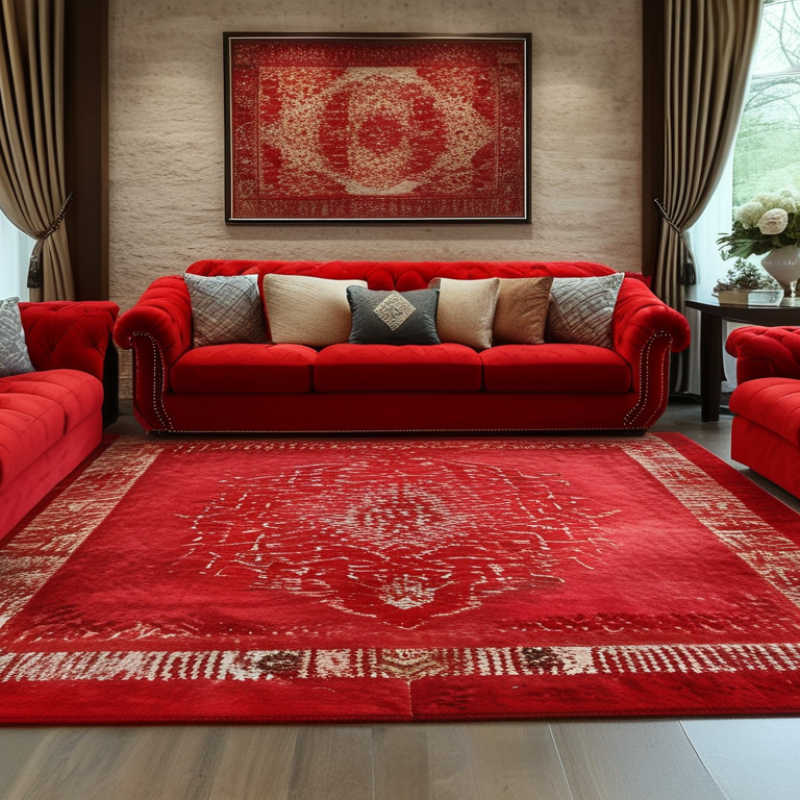
China’s Top Red Living Room Rug Suppliers: Industry Scope and Definitions
“China rug supplier” is a broad term. It may describe a factory, exporter, trading company, or private-label producer. For red living room rugs, the scope usually covers machine-made and hand-tufted products made from wool, polypropylene, polyester, or blended fibers. A working definition matters.
The Grand View Research report on the global carpets and rugs market estimates continued growth through 2030, supported by residential renovation and interior decoration demand. China remains an important manufacturing base because suppliers offer varied pile heights, backing materials, sizes, and custom patterns. The China National Bureau of Statistics also reports strong manufacturing activity in textile-related industries, although rug-specific figures are not always separated. That limits precise comparisons.
Reliable supplier assessment requires more than catalog images. Buyers should verify fiber composition, colorfastness, edge stitching, backing adhesion, moisture control, and packaging strength. Red dyes can appear different under showroom lighting. Requesting a physical sample is practical. Testing should follow recognized textile and consumer-product standards, including restricted-substance requirements for the destination market. Some suppliers provide factory inspection records and production samples; others rely heavily on intermediaries. This distinction is easy to miss. Pricing data also needs caution, since quotes may exclude packaging, inspection, shipping, or customization. My own evaluation would compare at least three suppliers using the same specification sheet, while accepting that initial samples may not perfectly represent bulk production.
The residential area-rug industry covers textile floor coverings designed for defined living spaces rather than wall-to-wall installation. In sourcing terms, a red living room rug is typically specified by color family, fiber composition, construction method, backing, pile height, dimensions, and intended use.
This chart compares the floor area of common residential rug formats. The dimensions are shown in centimeters, and the calculated areas are based directly on length × width. No company or brand data is included.
China Top Red Living Room Rug Suppliers?
China’s main rug manufacturing hubs offer different strengths. Shandong supports large-scale weaving and practical polypropylene production. Jiangsu is known for refined textile processing and detailed pattern work. Zhejiang benefits from strong textile networks and flexible private-label production. Guangdong connects rug manufacturing with furniture and interior design supply chains. These regional differences matter when sourcing a red living room rug.
Grand View Research valued the global carpets and rugs market at approximately US$72.39 billion in 2022. It also projected a 4.7% compound annual growth rate through 2030. This growth increases supplier choices, but quality still varies. A factory’s location does not prove its capability. Ask for production photos, fiber specifications, colorfastness results, and recent inspection records. Deep red dyes can shift under warm showroom lighting. That detail is easy to miss.
Tips: Request samples from two hubs. Compare pile density, backing grip, edge stitching, and color under daylight. Zhejiang may suit flexible orders, while Shandong may support larger volumes. Jiangsu deserves attention for decorative designs. Guangdong can be useful for coordinated home-furnishing programs. I would not judge a supplier from one sample alone. Batch consistency often needs a second review.
When evaluating China’s top red living room rug suppliers, measurable specifications matter more than polished catalog photos. Request a written MOQ, sample policy, and production lead time. MOQ affects cash flow, especially for custom red shades or private-label packaging. A lower MOQ can reduce risk, but it may increase unit cost. Ask whether the quoted MOQ applies per design, color, or total order. This detail is often unclear.
An 8–12 mm pile offers a useful balance for living rooms. It feels soft underfoot while remaining easier to vacuum than deeper shag. Confirm pile height after finishing, not only during weaving. Ask for a physical sample and inspect edge binding, backing adhesion, and color consistency under warm light. Weight should sit around 25–35 oz/yd² for a practical medium-density rug. However, weight alone does not prove durability. Fiber type, tuft density, and backing construction also matter. I would compare two samples with similar weights; the heavier one may still shed more. That is an easy mistake.
Tips: Put every metric on the purchase sheet. Record MOQ, finished pile height, oz/yd² weight, tolerance, and testing results. Request batch photos before shipment. A supplier explaining tolerances clearly appears more reliable than one promising “perfect” consistency. Still, trust needs evidence. Check sample performance after repeated vacuuming and several days of foot traffic. Small tests reveal uncomfortable surprises.
When comparing China’s top red living room rug suppliers, material evidence matters more than bright color or low pricing. Wool offers natural resilience and a warm hand feel, but buyers should request fiber composition, dye-fastness, and shrinkage results. The Textile Exchange Materials Market Report 2024 states that polyester represented about 57% of global fiber production in 2023. Recycled PET can reduce virgin-material demand, yet its safety depends on traceable inputs and controlled processing. Ask for recycled-content verification, not only a marketing claim.
TPR backing improves grip on smooth floors, especially beneath a heavy sofa. However, suppliers should disclose plasticizers, odor testing, and slip-resistance results. There is no single worldwide TPR rug standard, so test methods must be clearly identified. OEKO-TEX® STANDARD 100 testing checks textile components for harmful substances, including dyes and finishing chemicals. Its requirements vary by product class and intended contact. A valid certificate should match the exact rug construction, not a similar sample. Reports from the European Chemicals Agency also show why chemical compliance needs continual review; restrictions can change. I would still question any supplier offering only a scanned certificate.
Tips: Request a pre-production sample, then test the red pile under daylight and warm indoor light. Rub it with a damp white cloth. Check transfer, loose fibers, backing odor, and curled edges. Keep laboratory reports, batch numbers, and shipment samples together. Small details matter. Mistakes happen, even with experienced factories.
China Top Red Living Room Rug Suppliers?
Choosing a top red living room rug supplier requires more than comparing shade cards. In practical sourcing work, I check fiber samples, backing strength, edge finishing, and carton protection. A deep crimson can look elegant under warm lights, yet appear brown beside walnut furniture. Ask suppliers to send dyed samples in daylight and evening light. Small details matter.
Customization separates capable factories from simple trading desks. Confirm available sizes, pile heights, border patterns, labels, and packaging before requesting a quotation. Digital mockups help, but physical samples reveal loose fibers and uneven corners. One supplier may accept a 3 x 5 meter order, while another requires a larger minimum. That difference affects both budget and design flexibility. It is easy to overtrust a polished catalog. I have done that before.
A realistic lead time usually falls between 15 and 30 days after artwork, materials, and deposit approval. Request a dated production schedule, inspection point, and loading estimate. Export capacity also needs evidence. Check monthly output, container experience, destination documents, and the ability to handle mixed sizes. Ask whether red dyes are tested for colorfastness and restricted substances under the destination market’s rules. Delays often begin with unclear approvals, not weaving itself. A reliable supplier answers with records, not confident promises.
| Supplier Profile | Typical Product Focus | Red Color & Pattern Customization | Common Materials | Typical MOQ | Sample Lead Time | Bulk Lead Time | Export Readiness | Best Fit |
|---|---|---|---|---|---|---|---|---|
| Profile A Machine-made volume supplier |
Modern living-room rugs, low-pile area rugs, washable designs | Custom red shades, geometric patterns, labels, and standard size adjustments | Polypropylene, polyester, and blended yarns | 100–300 pcs/design | 7–12 days | 15–25 days | Regular container and less-than-container-load export; standard commercial documents | Retail programs seeking competitive pricing and repeat production |
| Profile B Digital-print customization supplier |
Printed red rugs, branded artwork, photographic and detailed patterns | High flexibility for Pantone references, artwork files, borders, and custom dimensions | Polyester microfiber, cotton blends, and anti-slip latex-backed constructions | 50–150 pcs/design | 5–10 days | 15–20 days | Suitable for parcel, pallet, and container shipments; artwork approval normally required | Online sellers, hospitality projects, and short-run collections |
| Profile C Hand-tufted premium supplier |
Thick-pile statement rugs, abstract red designs, and premium interior pieces | Custom shapes, pile height, carved details, color combinations, and woven labels | Wool, viscose, cotton, polyester, and mixed-fiber yarns | 20–80 pcs/design | 10–18 days | 25–30 days | Export packing and container consolidation available; production inspection is recommended | Boutique furniture stores, designers, and premium residential projects |
| Profile D Flatweave and reversible supplier |
Lightweight flatweave rugs, reversible red patterns, and easy-care collections | Custom weave patterns, stripe layouts, dimensions, edge finishing, and packaging | Polypropylene, recycled polyester, cotton, and jute blends | 100–500 pcs/design | 7–14 days | 18–28 days | Efficient for palletized and container shipments; compact packing helps reduce freight volume | High-volume retailers, seasonal ranges, and budget-conscious buyers |
| Profile E Eco-material and contract supplier |
Recycled-fiber rugs, commercial area rugs, and coordinated hospitality collections | Custom red colorways, recycled-content specifications, backing options, and carton marks | Recycled PET, recycled cotton, polypropylene, and wool blends | 200–1,000 pcs/design | 10–15 days | 20–30 days | Designed for repeat export orders; material documentation and testing should be requested per project | Hotels, property developers, and buyers with sustainability requirements |